


What Is Laboratory Fume Extraction Arms?
A laboratory fume extraction arm, often referred to as a fume extraction hood or a fume arm, is a highly flexible and adjustable device used to capture and extract harmful fumes, vapors, dust, and other airborne contaminants from laboratory settings. These devices are essential for maintaining a safe working environment by preventing inhalation of hazardous substances, which can cause serious health problems.
Advantages of Laboratory Fume Extraction Arms
Improves compliance with health and safety regulations
Using laboratory fume extraction arms helps businesses comply with occupational health and safety regulations, potentially reducing the risk of non-compliance and associated fines.
Suitable for most welding processes
Laboratory fume extraction arms are versatile and can be used for a variety of welding processes, including MIG, TIG and stick welding, making them a flexible option. This is why extraction arms are ideal for welding schools, where students have to learn a variety of processes.
No need to change welding guns
Unlike fume extraction MIG welding guns, laboratory fume extraction arms work independently of the welding equipment.
Very efficient if positioned properly
If positioned correctly, laboratory fume extraction arms are very effective at capturing and removing harmful fumes from the welder’s surroundings, directly contributing to a healthier work environment.


Product Categories
Latest Products


Why Choose Us
Highly customized
We are a factory that provides solutions from smoke extraction arm design, production and installation to after-sales, with excellent quality and fast delivery.
High quality
The company introduces advanced European indoor air purification and filtration technology and product manufacturing technology, relying on high-quality professionals, and always pays attention to the quality of the fume purification system.
Quality control
We always pay attention to the quality of the smoke extraction system.
Quality assurance
We will provide a five-year warranty and lifetime maintenance.
Types of Laboratory Fume Extraction Arms
Ducted arms
These are fume extraction arms connected to a duct system that delivers the fumes to a central filtration unit. They are often used in large-scale operations where multiple sources of fumes need to be captured and filtered.
Portable arms
Portable fume extraction arms are mounted on a portable base or cart and can be easily moved from one location to another. They are ideal for smaller operations where mobility is important.
Articulated arms
These are fume extraction arms that are made up of multiple sections or joints that can be adjusted to reach the source of the fumes. These are fume extraction arms that are made up of flexible hoses or tubes that can be bent and manipulated to reach the source of the fumes. They are ideal for applications that require a large reach, but need to capture the fumes from different angles.
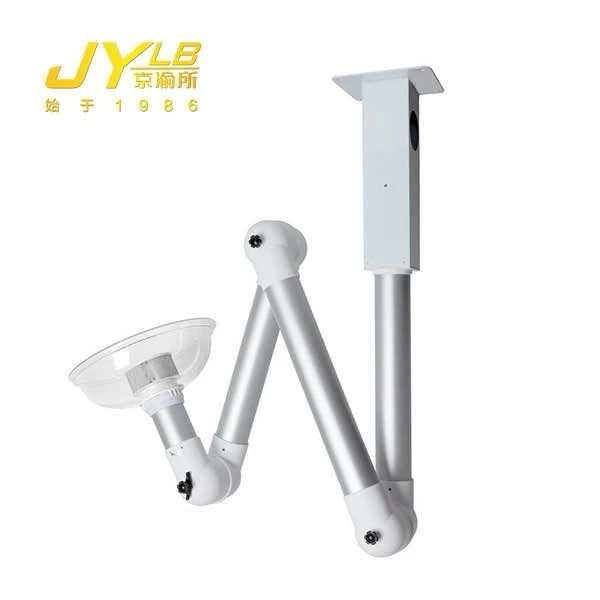
Ceiling arms
These are ceiling mounted fume extraction arms, usually above a workstation or process. They are ideal for applications where floor space is limited and the fumes need to be collected from above.
Application of Laboratory Fume Extraction Arms
Healthcare
Did you know that many pharmaceutical companies and their laboratories implement extraction arms throughout their facilities? Pill production involves exposure to various compounds and chemicals that are not safe for humans. As such, lab techs use extraction arms for local ventilation.
Other healthcare industries use these devices as well, including dentistry. Dentists use them in the procedure room to eliminate "surgical smoke," which is a byproduct of their operations and is known to cause cancer. They also use the arms to eliminate biological waste like microparticles of blood and spit.
Artifact Preservation
Yes, this heavy-duty welding device is a popular machine in the artifact preservation industry. Professionals who carefully dust and exhume ancient artifacts need a way to eliminate dust buildups without damaging the piece conveniently. They use extraction arms to suck up excess materials, allowing them to properly and safely preserve a piece of history.
Artwork
Many artists use source capture devices while they work, mainly stained glass makers and lithographers. The production process for both of these crafts involves harmful chemicals that produce dangerous emissions. Having an extraction arm mere inches away from their projects protects both the artists and the art.
Food Production
Health and safety regulations mean that food production processes must adhere to cleanliness. You don't want biological cross-contamination happening in a food plant, spoiling countless shipments of products that are potentially harmful to customers. That's why food manufacturers implement extraction arms throughout their factories to maintain sanitized air quality.
Woodworking
Remember how dust piles are not welcomed in an industrious workshop? Well, woodworking produces a significant amount of debris that quickly accumulates in small spaces. This is the case for any size of operation, from massive businesses to a hobbyist's garage setup.
Harmful fumes are generated from a lot of applications and it is essential to have a proper fume extraction even by law and otherwise. Be it lathes, repair centres, manufacturing units, or assembly units, harmful fumes are generated that can cause a great risk to human health and the environment. Harmful smoke and fumes are generated from all types of welding and soldering processes.
Depending on the components involved in the applications, the toxicity of the fumes varies. E.g.: In welding processes, the workers are exposed to huge levels of manganese as the level of manganese in welding rods is high.
It’s the manganese that helps to strengthen the welded metals. Once entered into the blood, manganese is likely to act quickly on the human nervous systems, respiratory systems, kidneys etc. Long-term exposure to manganese can even cause lung, and larynx cancers and urinary tract.
Exposure to soldering applications can lead to workers inhaling formaldehyde, a kind of fumes, lead oxide, hydraulic acid and various other harmful gasses that contain toluene, benzene, styrene, chlorophenol, phenol, isopropyl alcohol etc. Inhaling these harmful gasses can cause indigestion, nausea, vomiting, loss of appetite, nervousness, headache, abdominal cramps, constipation, and many other long-term throat and respiratory and skin problems.
Not only applications involving welding and soldering processes, but even a nail salon would also emit harmful vapours that can lead to potential health risks.
Hence individuals and companies need to install a proper fume extraction system that is designed, installed and maintained perfectly to serve the purpose of extracting hazardous fumes and particles through a filtration system to ensure a safe workplace.
Components of Laboratory Fume Extraction Arms

Vacuum unit
The system’s heart generates suction to capture welding fumes.

Extraction tools
These tools capture welding fumes at the source and can include flexible arms, MIG extraction guns, nozzles, hoods, etc.
Dust collector
This component filters and collects the extracted particulates and fumes. In stationary systems, it is a separate unit; in portable systems, it’s integrated with the vacuum unit.

Ventilation network
Includes ducts and hoses that transport fumes from the extraction point to the dust collector. In portable units the network is typically a simple hose, whereas stationary systems use a more complex arrangement of ducts and hoses.
How to Maintain Laboratory Fume Extraction Arms
Regular inspections
Regular inspections are fundamental to effective chemical extraction maintenance. Inspect the extractor unit, ducting, filters, and fans regularly, preferably following the manufacturer's recommendations. Look for any signs of wear, corrosion, or damage that could affect performance.
Clean filters
Filters are an important part of the laboratory fume extraction arm, capturing harmful particles and gases. Over time, laboratory fume extraction arms can become clogged with debris, which reduces airflow and efficiency. Schedule regular cleaning or filter replacement based on usage and manufacturer guidelines. While some filters can be used after cleaning, some simply need replacement.
Check airflow
Proper airflow is essential for effective fume extraction. Regularly check the airflow of your extraction system to ensure it meets recommended specifications. Use an anemometer or airflow meter to measure airflow at various points along the duct. If airflow is insufficient, it could indicate a clogged mobile fume extractor, obstructed ducting, or fan failure that requires attention.
Monitor noise levels
Unusual noises such as grinding, squealing, or clicking could indicate a mechanical problem inside the fume extractor. Monitor noise levels during operation and investigate any unusual sounds promptly. Addressing mechanical issues early can prevent further damage and downtime.
Inspect the ductwork
The ductwork carries fumes extracted from the welding area to the extractor unit. Regularly inspect the ductwork for any signs of damage, leaks, or blockages. Make sure ductwork joints are properly sealed to prevent fumes from escaping into the work area. Clean the ductwork as needed to remove accumulated debris that could impede airflow.
Lubricate moving parts
Many laboratory fume extraction arms contain moving parts, such as fans or motors, that require lubrication to operate smoothly. Refer to the manufacturer's instructions for recommended lubricants and lubrication intervals. Excessive lubrication can attract dust and debris, causing performance issues, so follow the guidelines carefully.
Train operators
Proper maintenance of laboratory fume extraction arms also involves training operators on use and maintenance procedures. Provide comprehensive training to those responsible for operating and maintaining the equipment. Emphasize the importance of adhering to the maintenance schedule and reporting any problems promptly.
Record maintenance activities
Detailed records of maintenance activities are essential to tracking the condition of the laboratory fume extraction arm and ensuring regulatory compliance. Create a maintenance log that includes the dates of inspections, cleanings, filter changes, repairs, and any observations or issues found during inspections.
Bottom line
While you follow the above tips to maintain the operation of your mobile fume extraction system, it is also important to replace them in a timely manner. Because the way depreciation costs work is that they cause the machine to deviate from optimal working condition. If you need a new welding fume extraction system.
Install Fume Extractors to Ensure Industrial Safety


Evaluation of fume generation sources
A study of all processes in the workplace is the first step. Process hazard evaluation should be conducted for all the processes in the workshop, this should reflect all fume and dust hazard. Collecting contaminants from the different workplaces are only possible if the metals worked at the station are non-reactive to each other. For example, aluminum and iron oxide form a combustible combination. In cases like those, separate fume extraction units are required. In case the metals worked are non-reactive a single extraction will be a more viable option.
Design a process friendly duct and extraction arm system
It is essential that the extraction unit is user-friendly and will not add any or much process time which could affect the profitability of the finished product itself. Extraction arms shall be a system of movable and flexible capture hood that can capture fumes generated from the whole work table.
Ensuring required fume capture velocities at all contamination sources
For capturing the fumes a minimum of 100fpm is required normally when the capture arm hood is placed 2inces from the fume source. This means if you are using an arm hood with an area of 0.25sqm, you should have 270cfm flow at the hood inlet. In case, capture hood is placed 4inces from the source the cfm requirement is double, ie; 540cfm. The main fan for the unit shall be designed accordingly to provide these required cfm at each work station extraction hood inlets.
Choose an appropriate dust collector and filters
As discussed above fan-selected should have the capacity to provide required cfm at all fume sources. For handling thermally generated dust like weld fumes, it is recommended to use a cartridge style dust collector, equipped with flame-retardant filter and uses a nanofiber filter. These filters shall be cleaned at set regular intervals and should be replaced when damaged.
How the Laboratory Fume Extraction Arms Works
Pretreatment
Connect the smoke treatment equipment to the air source, and filter and pre-treat the coarse particles and impurities in the air through the filter to prevent damage to the subsequent treatment devices and systems.
Electrostatic adsorption
Introduce the pre-treated air into the electric field area, and use the high-voltage electrostatic field to attract the smoke particles in the air. These particles will be charged and gather on the collection plate in the electric field. Electrostatic adsorption technology can efficiently remove small particles of smoke substances.
Activated carbon adsorption
The air after electrostatic adsorption is guided through one or more layers of activated carbon adsorption layers. Activated carbon has a large surface area and adsorption capacity. Under the action of physical adsorption and chemical adsorption, it can adsorb and degrade harmful gases, odors and other pollutants in the air. Activated carbon adsorption technology is mainly aimed at the removal of harmful gases and odors.
High-efficiency filtration
In smoke treatment equipment, high-efficiency filters are usually installed to further remove microscopic particles and microbial substances such as bacteria and viruses. High-efficiency filters can effectively filter tiny particles and microorganisms in the air through their special filter media, such as high-efficiency filter paper, glass fiber, etc.
Negative ion generator (optional)
Finally, the smoke treatment equipment can choose to add a negative ion generator, which generates a large number of negative ions and combines them with positive ions and particles in the air to generate larger particles, which eventually settle to the ground or are trapped by the filter, achieving the removal of tiny particles in the air. Negative ion generators are generally used for air purification and restoration of indoor air quality.
FAQ
We're professional laboratory fume extraction arms manufacturers and suppliers in China, specialized in providing high quality customized products. We warmly welcome you to buy bulk laboratory fume extraction arms in stock here from our factory. For pricelist, quotation and free sample, contact us now.
fume extraction arms for electronics labs, quality control laboratory fume extraction arms, fume extraction arms for energy labs